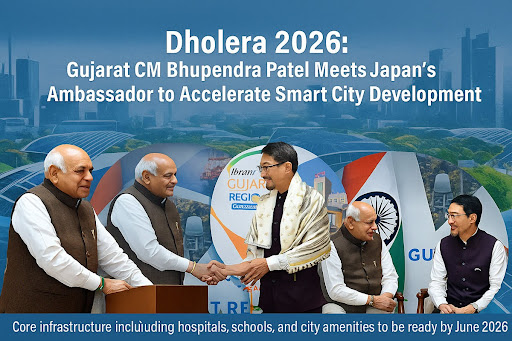
Dholera, Gujarat — In a major development for India’s first greenfield smart city, Chief Minister Bhupendra Patel has stated that Dholera’s essential social infrastructure—hospitals, schools, and key civic amenities—will be completed by June 2026.
The announcement underscores the state’s intent to accelerate not just industrial expansion but also the creation of a truly livable city under the Dholera Special Investment Region (SIR) initiative.
The statement came during Patel’s meeting with the Japanese Ambassador to India, Hiroshi Suzuki, and a delegation of senior Japanese officials. Japan is one of the largest overseas partners in the Delhi–Mumbai Industrial Corridor (DMIC) and has shown consistent interest in Dholera’s smart-city ecosystem.
A Global Context: Japan’s Interest in Dholera
During the high-level meeting, the CM highlighted Gujarat’s progress in developing Dholera as a world-class industrial and residential city. The Japanese delegation reaffirmed Japan’s willingness to invest in advanced manufacturing, green energy, and mobility sectors in Gujarat, particularly in and around Dholera.
Patel assured the delegates that by mid-2026, Dholera would be fully equipped with its core social infrastructure—a functional hospital, modern schools, fire and police services, and ready-to-occupy housing clusters—making it an ideal environment for global companies to set up long-term operations.
This diplomatic exchange underscored how Dholera’s readiness is not only a state objective but also a signal to international investors that Gujarat is serious about building a complete, sustainable city.
What the announcement means
Dholera is entering a decisive stage where industrial readiness and citizen facilities will progress in parallel. The plan covers:
- Construction of a 200-bed multi-specialty hospital in the Activation Area.
- Establishment of schools, technical institutes, and training centers for the growing workforce and resident families.
- Development of fire stations, police facilities, and housing across early Town Planning Schemes (TP1–TP4).
These initiatives complement Dholera’s core trunk infrastructure—arterial roads, underground utility corridors, storm-water systems, and power networks—which are already operational in key zones.
Dholera: from blueprint to reality
India’s most ambitious smart city, Dholera is a star project of the Delhi–Mumbai Industrial Corridor (DMIC). With an area of around 920 sq km (around 422 sq km of developable area), it’s planned to combine advanced manufacturing factories with smart residential neighbourhoods for its workforce and public amenities.
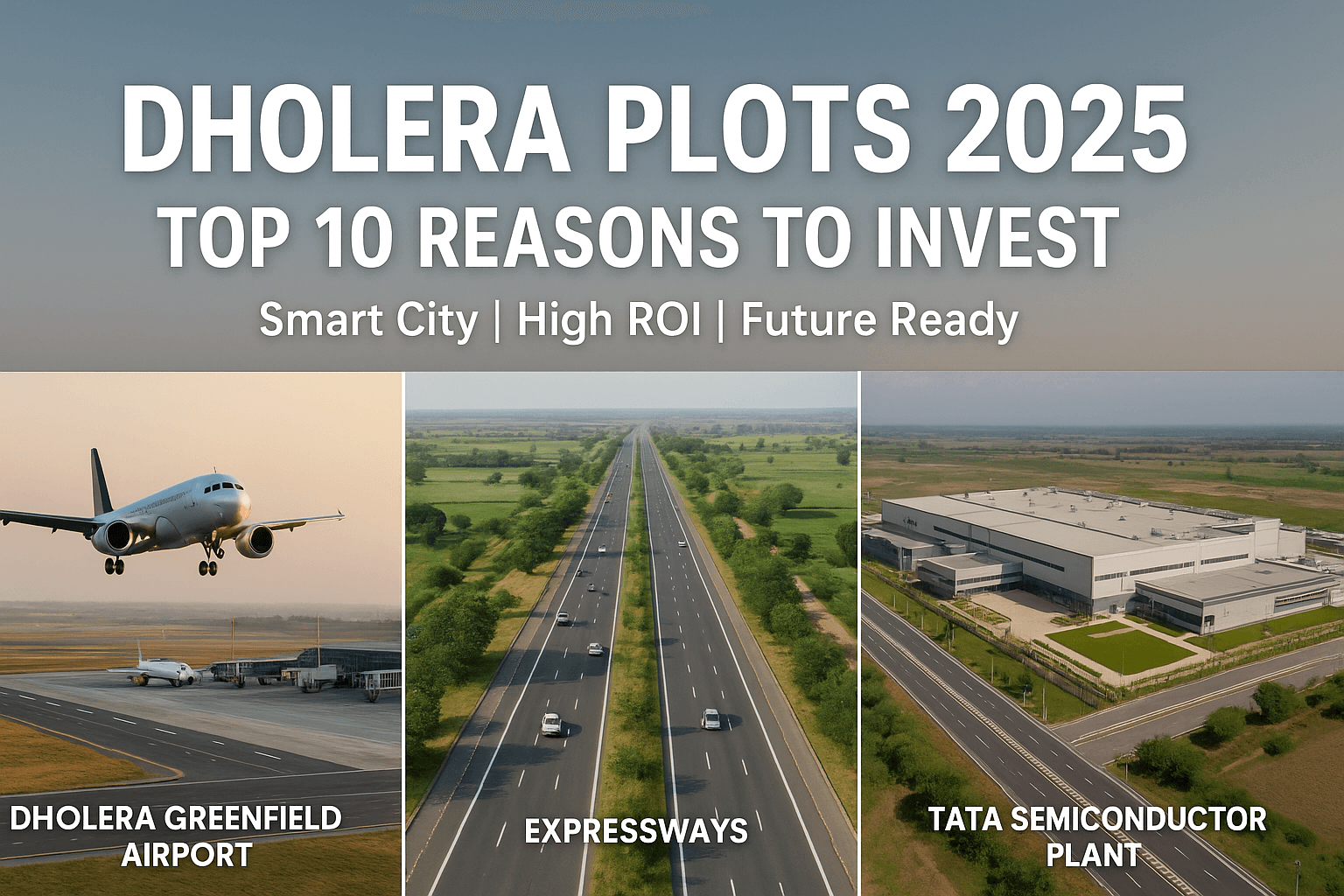
Momentum has grown with anchor projects such as the Tata-PSMC semiconductor plant, large-scale renewable energy parks, and the Dholera International Airport. Social infrastructure—hospitals, schools, emergency services—now forms the missing piece that converts an industrial site into a complete, livable city. Recent announcement from Gujarat’s CM about schools and hospitals is good news for investors wishing Dholera’s success.
Government support and budgeting
Recent state budgeting has earmarked funds for Dholera’s social infrastructure, including schools, a hospital, emergency services, desalination capacity, and public utilities. Groundwork activities for the first hospital have begun, with provisions for diagnostics, trauma care, and emergency response designed to serve both workers and residents.
Why this matters
Dholera’s reputation has often centered on mega-infrastructure like expressways and logistics corridors. But a city becomes truly livable when social infrastructure matures alongside industry.
Hospitals and schools are more than amenities; they’re signals of permanence that encourage employees to relocate with families, boosting residential uptake and stabilizing the urban ecosystem.
Expert perspective
Urban development specialists call the target ambitious but achievable, provided execution stays disciplined. Critical success factors include:
- Tight synchronization of water, power, and digital utilities with public buildings.
- Consistent funding and transparent, milestone-based reporting.
- Effective public–private partnerships for operations and maintenance once assets go live.
Tracking the 2026 goal
Watch for these markers over the next 12–18 months:
- Public buildings rising: hospital, schools, fire and police facilities.
- Utility readiness: commissioning of water, power, telecom, and wastewater assets tied to these buildings.
- Early residential occupancy: housing clusters in the Activation Area receiving their first residents and staff.